“7 Bizarre Midwest Monuments”
The American Midwest is known for three things: endless cornfields, polite people, and a deep, unexplainable urge to build gargantuan tributes to absolutely random objects. When you’ve got that much flat, open space, I guess you start getting creative. Forget the Grand Canyon or the Statue of Liberty; true cultural enlightenment is found off a dusty two-lane highway, staring up at a monument that makes you question the sanity of civil engineering. Welcome to Weird and Wacky Wonders, where we’re taking a road trip through the heartland to witness the magnificent, the baffling, and the slightly unhinged. Buckle up.
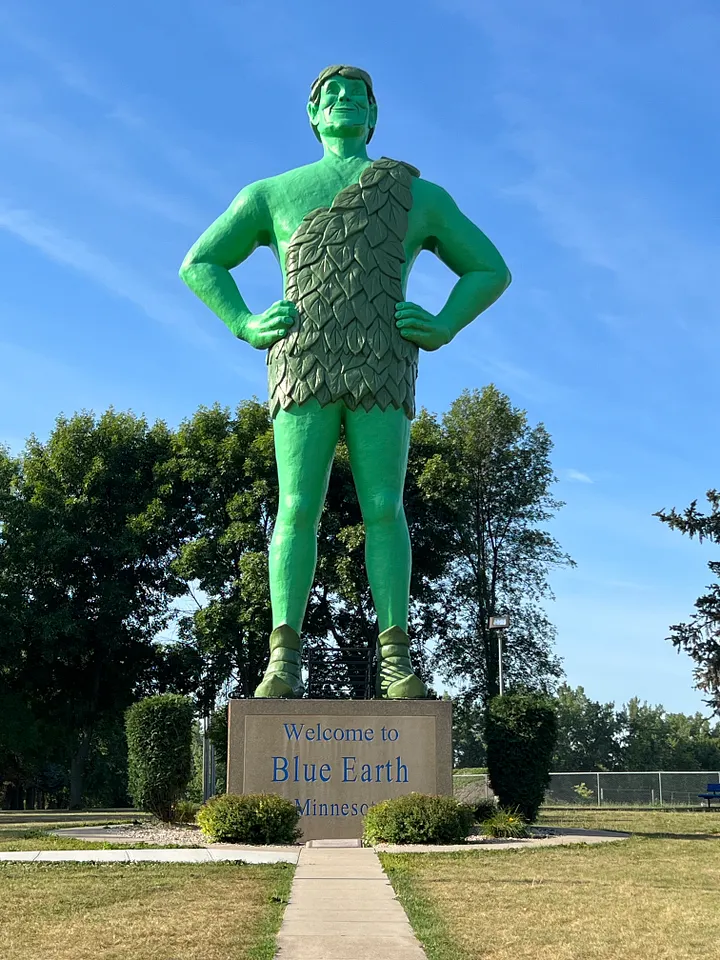
1. The 55-Foot Jolly Green Giant (Blue Earth, MN)
If you’ve ever wanted to feel completely inadequate while being judged by a towering, verdant mascot of canned vegetables, Blue Earth, Minnesota, has exactly what you need. Looming 55 feet into the sky, the Jolly Green Giant stands with his hands planted firmly on his leafy hips, staring off into the middle distance. He’s constructed from fiberglass, sports a custom size-78 sandal, and emits an aura that is equal parts cheerful and terrifying. You simply cannot drive past without stopping to stare at his impeccably sculpted, green fiberglass kneecaps.
The weird history: Why build a colossus of a marketing mascot? In 1978, local radio station owner Paul Hedberg realized that the newly completed Interstate 90 was going to bypass Blue Earth completely, taking tourist dollars with it. To lure motorists off the highway, he convinced the town to erect this massive, emerald behemoth as the ultimate roadside thirst trap. It worked flawlessly.
2. The Biggest Ball of Twine Rolled by One Man (Darwin, MN)
There are several giant balls of twine scattered across America, but the one in Darwin, Minnesota, demands your ultimate respect because it wasn’t a group project. Sitting proudly inside a custom-built, glass-enclosed gazebo—because you must protect fine art from the elements—is a 17,400-pound, 12-foot-wide spherical monument to sheer, unadulterated obsession. It looks like an asteroid made entirely of brown string, heavy enough to possess its own gravitational pull.
The weird history: This wasn’t a town gimmick. This was the solitary life’s work of a single man named Francis A. Johnson. Starting in 1950, Johnson meticulously wrapped twine for four hours a day, every single day, for 39 years. He used a custom jack to hoist it as it grew larger and heavier. Why? Nobody really knows, but his relentless dedication earned him a permanent spot in weird roadside lore and a dedicated song by “Weird Al” Yankovic.
3. World’s Largest Collection of Smallest Versions of Largest Things (Lucas, KS)
Prepare for a roadside attraction that will shatter your perception of reality with layers of pure, meta irony. Located in the eccentric art town of Lucas, Kansas, this isn’t just a monument; it’s a mobile museum. Housed inside a heavily decaled, wonderfully chaotic Ford van, you will find meticulously crafted, bite-sized replicas of the world’s largest roadside attractions. You can see a tiny version of the World’s Largest Ketchup Bottle, or a miniature replica of the aforementioned Giant Ball of Twine, all displayed like crown jewels.
The weird history: This mind-bending collection is the brainchild of artist Erika Nelson. Instead of just visiting giant things, Nelson decided the logical next step was to build a tiny version of every giant thing, travel to the giant thing, and photograph her tiny thing in front of the giant thing. It was built purely to poke fun at America’s obsession with “World’s Largest” monuments by creating the ultimate paradox.
4. FAST Fiberglass Mold Graveyard (Sparta, WI)
If you’ve ever wondered where nightmares and roadside oddities are born, look no further than Sparta, Wisconsin. The FAST (Fiberglass Animals, Shapes and Trademarks) Mold Graveyard is less of a monument and more of a surreal, slightly apocalyptic petting zoo. Strolling through this overgrown field, you’ll encounter the hollow, disembodied shells of giant grinning mice, massive ice cream cones, oversized skulls, and a chaotic jumble of colossal animal parts. It is eerie, fascinating, and looks exactly like the aftermath of a carnival explosion.
The weird history: This wasn’t built as an attraction at all. The FAST corporation is one of the premier manufacturers of those weird, giant fiberglass statues you see outside miniature golf courses and eccentric businesses worldwide. Once they finish a custom order, the massive, hollow industrial molds are simply dragged out into the back field and left to the elements. Over the years, the sheer volume of discarded oddities accidentally transformed the company’s backyard into a mecca for weird-tourism.
5. The Mitchell Corn Palace (Mitchell, SD)
The Mitchell Corn Palace is a true testament to the fact that with enough crop yield and sheer willpower, you can build anything. From a distance, it looks like a grand, Moorish-revival castle complete with onion domes and minarets. But as you get closer, the bizarre reality sets in: the massive, intricate murals wrapping the entire exterior are constructed completely out of thousands of ears of naturally colored corn, native grasses, and grains. It is a spectacular, architectural-scale arts and crafts project that smells faintly of a feed store.
The weird history: Why build a palace out of poultry feed? The original Corn Palace was erected back in 1892 with a very specific, somewhat desperate agenda. South Dakota wanted to prove to skeptical East Coast residents that their state had a thriving, healthy agricultural climate, completely defying rumors of barren lands. To prove their point, they literally glued their harvest to a building. The craziest part? They strip the entire building bare and create brand-new corn murals every single year.
6. Carhenge (Alliance, NE)
England has the mystical, ancient standing stones of Stonehenge. Nebraska has Carhenge, which is arguably much cooler and definitely requires a recent tetanus shot. Rising inexplicably from the flat, windswept high plains of Alliance, Nebraska, this monument consists of 39 vintage American automobiles—ranging from Cadillacs to Plymouths—rescued from farms and dumps. They have been half-buried, stacked, and welded together in the exact physical proportions of the original Stonehenge, all unified by a thick coat of matte gray spray paint to mimic the ancient stones. It is an automotive triumph of weirdness.
The weird history: You might assume this was an eccentric art installation funded by a quirky grant, but it was actually deeply personal. Jim Reinders built Carhenge in 1987 as a memorial to his father, who had lived on that very farm. Reinders had studied the real Stonehenge while living in England, and upon returning, he and his family spent a week during a family reunion planting cars in the dirt. It was a joke that accidentally became a permanent cultural landmark.
7. The World’s Largest Pitchfork (Richards, MO)
Tucked away in the tiny town of Richards, Missouri (population: barely enough to field a baseball team), stands a farming implement fit for a giant. The World’s Largest Pitchfork stabs proudly into the Midwestern soil, towering over 60 feet in the air and weighing in at nearly 2,000 pounds. Made of solid steel and meticulously painted with a classic red handle and silver tines, it’s a beautifully absurd slice of oversized Americana. It stands there, completely devoid of giant hay bales, daring the heavens to drop a massive pile of manure.
The weird history: The genesis of this colossal tool is a classic tale of American entrepreneurial spirit mixed with a dash of “why not?” It was commissioned by a local restaurant owner who simply wanted a definitive, undeniable “World’s Largest” item to stick next to his business to force people to pull over. He chose a pitchfork to honor the heavy agricultural roots of the surrounding area. It was built and erected in 2022, proving that the great American tradition of building unnecessarily massive things to sell burgers is still alive and well.